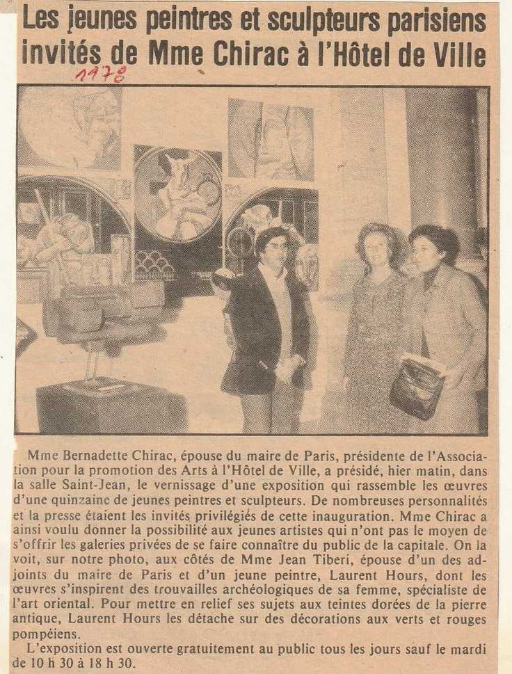
In 1978, a young Moroccan painter living at 10 rue de Marignan in Paris's 8th arrondissement received an invitation that few artists of his generation — and fewer still from his background — would ever receive: to exhibit at the Hôtel de Ville de Paris, alongside a selection of young painters and sculptors chosen by Bernadette Chirac, wife of the Mayor of Paris and president of the Association pour la promotion des Arts.
The coupure de presse is modest in format. A black-and-white photograph, a few lines of text. But for Mohamed Azouzi — born in 1946 in Casablanca, Morocco, with roots in the Tafilalet, trained at the École des Beaux-Arts de Casablanca and then at the Atelier Jean Bertholle at the École Nationale Supérieure des Beaux-Arts de Paris — it marks a threshold. His first appearance in the French press. His first public recognition in the city that had adopted him.
A painting that stopped the Musée d'Art Moderne
What no short press notice could anticipate was what followed. On 19 July 1978, the Musée d'Art Moderne de la Ville de Paris acquired a work by Mohamed Azouzi for its permanent collection.
The painting was Planche coranique — oil on canvas, dated 1975, inventory number AMVP 2117. It remains in the museum's collection to this day.
To look at Planche coranique is to understand immediately why it could not be ignored. The surface evokes an ancient manuscript, a fragment of stone, a Quranic tablet worn by time and light. Arabic letters — liberated from their strictly linguistic function — move across a ground of deep ochres and burnished browns with the authority of ancient inscription and the freedom of modern gesture. A narrow band at the base, geometric and spare, anchors the composition like the footer of a sacred text.
This is not decorative calligraphy. It is something more demanding: an attempt to hold, within a single pictorial surface, the weight of two civilisations — the Arabic written tradition and the Western painterly one — without flattening either into the other.
The youngest heir of a double lineage
At the time of this acquisition, Azouzi was 29 years old. He had been in Paris for only a handful of years, working in the orbit of Jean Bertholle — a painter himself formed by Bissière, whose influence on a generation of European abstractionists was profound. The link is not incidental: in Planche coranique, one can read both the material tenderness surfaces and the formal rigour of Arab geometric tradition.
The Musée d'Art Moderne de la Ville de Paris did not acquire works lightly. That it chose a young Moroccan painter, working at the intersection of two traditions that French artistic culture had rarely brought into genuine dialogue, speaks to the singular quality of what Azouzi was already producing in his studio on the rue de Marignan.
The beginning of a long arc
This acquisition in 1978 was not an isolated gesture. It was the opening note of a recognition that would unfold across five decades — through collections at the Bibliothèque Nationale de France, UNESCO, the Fondation Hassan II and the Musée Mohammed VI d'Art Moderne et Contemporain in Rabat, through exhibitions in New York, Tokyo and Moscow, and ultimately through the classification in 2025 of one of his works as National Heritage of the Kingdom of Morocco.
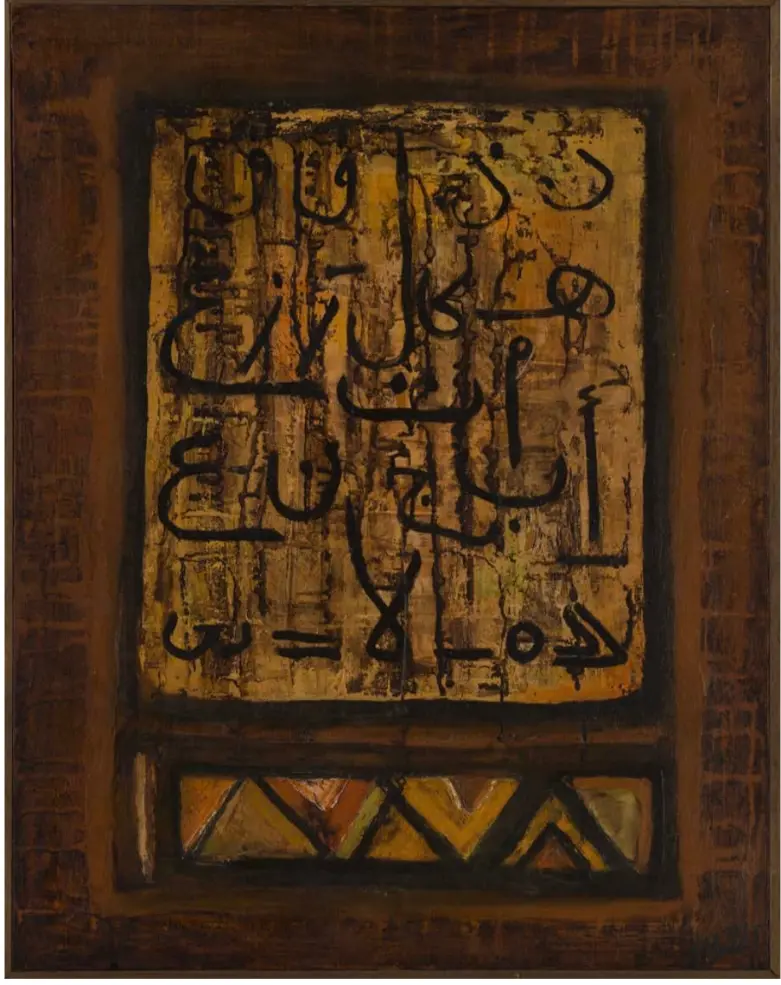
Planche coranique, 1975 - Musée d'Art Moderne de la Ville de Paris Inventaire AMVP 2117
Oil on canvas. Permanent collection.
→ Discover the works of Mohamed Azouzi
Our latest articles
Discover our most recent publications.